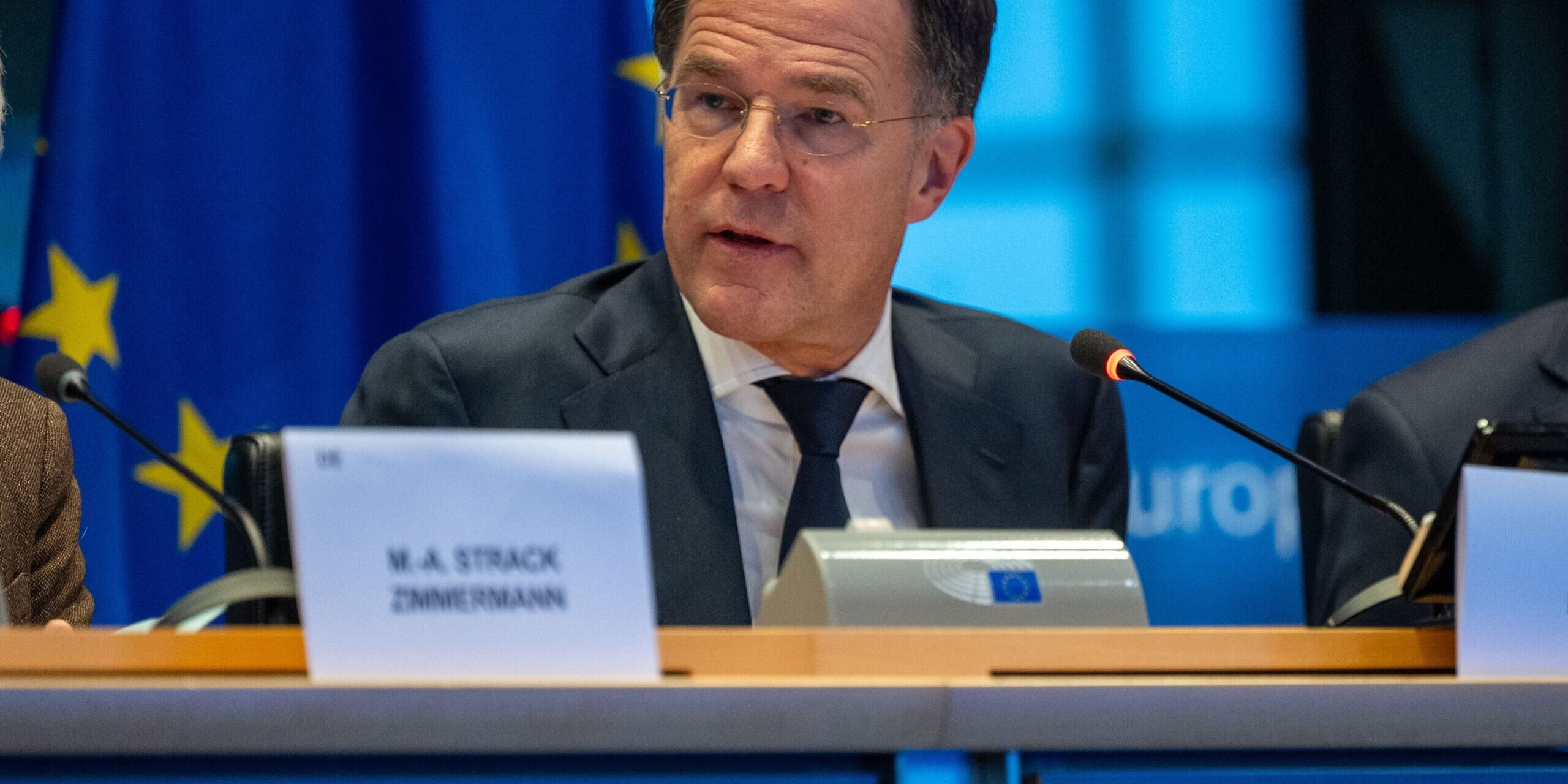
While highlighting the interdependency and symbiotic relationship between NATO Europe and the European Union, NATO Secretary General Mark Rutte has nevertheless stressed in a recent speech that “if anyone thinks … that the European Union, or Europe as a whole, can defend itself without the US, keep on dreaming. You can’t.”
Rutte was addressing a meeting of the European Parliament’s Committee on Foreign Affairs (AFET) and Committee on Security and Defence (SEDE) in Brussels on 26 January 2026. His speech came in the wake of the 2026 World Economic Forum summit, held in Davos, Switzerland, from 19 to 23 January, at which US President Donald Trump had doubled down on his scheme for the United States to take control of the sovereign Danish territory of Greenland. Faced with a newly galvanised rejection from the United States’ European allies of this plan, Trump was forced to back down. Trump’s avarice over Greenland, however, had plunged NATO into a crisis of allegiance that is only now dissipating.
Trump had additionally poured petrol onto the fire over Greenland by stating in an interview with Fox News on 22 January of the United States’ NATO allies, “We’ve never needed them. … They’ll say they sent some troops to Afghanistan … and they did; they stayed a little back, a little off the frontlines.”
That comment drew a wave of anger and condemnation among US European allies whose armed forces had suffered numerous deaths fighting alongside US forces in both Afghanistan and Iraq. Even UK Prime Minister Sir Keir Starmer, who along with Rutte has previously trod lightly in his dealings with Trump, stated on 23 January that the US president’s comments were “insulting and frankly appalling”.
In his address to the AFET and SEDE on 26 January, Rutte reiterated he had reminded Trump at Davos that, in the wake of the 9/11 terrorist attacks on the United States in 2001, the operation in Afghanistan was the only time NATO’s Article 5 mutual defence treaty had been invoked. Rutte said he emphasised to Trump at Davos that, “for every two American soldiers who paid the ultimate price, one soldier of an Ally or a partner, a NATO Ally or a partner country, did not return home”.
Rutte nevertheless argued that the US president “is doing good stuff” with regard to NATO. “I know I’m irritating a lot of you again, but I think so, because as I said, also in Davos, the 2% [of GDP spent on defence] reached by all NATO countries now at the end of 2025 would never, ever, ever have happened without Trump,” said Rutte. “He [Trump] had one big irritant, one big pebble in the shoe, which is there since [34th US President Dwight] Eisenhower: the fact that the Europeans were not paying up. And with the NATO defence commitment in The Hague, the outcome of The Hague summit on spending [in June 2025], and also on industrial production in Ukraine, but particularly here on spending, we are now equalising with the US. So that irritant is gone. So there is a total commitment by the US to NATO Article 5, but also an expectation that Europeans and Canadians will pay more. And we are doing so.”
In his remarks Rutte also touched upon the vague agreement that NATO Europe agreed with Trump over Greenland at Davos.
“What we agreed is, I think, two workstreams going forward. One workstream is for NATO collectively to take more responsibility for the defence of the Arctic. As you know, there are seven countries in the Arctic. There’s the US through Alaska, and, of course, Canada, Denmark, because of Greenland. And then we have Iceland, Norway, Finland, Sweden. Yes, these are the seven countries bordering on the Arctic,” said Rutte. “The eighth one is Russia, obviously not in NATO. So one workstream will be to see how best, collectively, we can prevent the Russians and the Chinese getting more access to the Arctic region, becoming also militarily more of an adversary there … NATO clearly being in charge here.”
The second workstream, said Rutte, addresses two issues: Russia and China, and “how to prevent these two countries from gaining access in a military sense or an economic sense to the Arctic.”
Rutte noted that “There is an issue of collective security, because these sea lanes are opening up, and because the Chinese and the Russians are more and more active. China, of course, not bordering on the Arctic, but as you know very much being involved there together with the Russians. So clearly, we have to address that, and that means that, when it comes to this question of capabilities, we will see in NATO how we tackle this.”
Speaking on the potential for a peace agreement in the Ukraine conflict, Rutte said that “Obviously, the security guarantees are extremely important. And as you know, there are three layers. One layer is the Ukrainian Armed Forces. Going forward, they will be the first line of defence. The second line of defence being the Coalition of the Willing, providing training, providing, for example, also support in terms of the military build-up of [the] Ukrainian Armed Forces. So, this is led by the French and the Brits, as you know. And, of course, the US becoming more and more involved, as you know, since last summer. And as the President of Ukraine said yesterday – and I think he is right – these security guarantees are close to being agreed upon. But then, of course, there is the other issue, which is the rebuilding of Ukraine.
“And the third issue is the very sensitive issue of territory,” said Rutte. “In the end, it is only the Ukrainian government who can decide on territory. But for the Ukrainian government to get its head around what they can accept in terms of a compromise on territory, it is crucial for them to know that, going forward, the Russians will not try to attack Ukraine again. Preferably, of course, they would love for Ukraine to be in NATO, but as you know various NATO nations are at the moment blocking that. There is this irreversible path into NATO that will still be there, but at the short term it’s politically, it’s practically now not on the cards, and that means that the security guarantees are the more crucial to prevent the Russians from ever attacking again.”